Making Organoids
Seed 96 wells from one stem-cell culture, then feed the simulated aggregates through day 18.
 GPT-6 Astra
 Claude Opus 5.5
 Grok 4.7
 Kimi K3
 Gemini Argon
Loading recorded plate transfers…
Task & tools
Starting setup
- A ready iPSC source plate with one occupied well.
- Prepared Accutase, room-temperature PBS, refrigerated PSI1, supplement stocks and Trypan Blue.
- An ultra-low-attachment V-bottom 96-well plate, conical tube, sample tube and reservoir.
Available tools
- P20, P1000, eight-channel pipette and gripper.
- Cell counter with a disposable counting slide.
- Microscope, incubator and centrifuge.
Agent responsibility
- Build, validate and execute native tcode scripts.
- Count cells, calculate the dilution and choose tools, tips, volumes and wells.
- Prepare age-appropriate media and coordinate instrument jobs with scheduled care.
- Inspect failures and resume from committed state.
Execution interfaces
Write Python using tcode-api 1.40.1 and submit a TCodeScript with explicit tools, tips, positions, ASPIRATE and DISPENSE. Stock retrieval, incubation, centrifugation and counting use separate workcell services. Supported protocol mistakes execute; only the grader assigns PASS/FAIL.
Agent Context
Open Agent Context to read the files.
Protocol
Wash and detach
Remove the spent medium. Wash each occupied well with 1 mL room-temperature PBS and aspirate it. Add 1 mL Accutase and incubate at 37 °C for 5–10 minutes. Retrieve unsupplemented PSI1 from the fridge, add 1 mL per well after incubation and pipette up and down at least three times. Transfer 2 mL per occupied well to a conical.
Spin, resuspend and count
Centrifuge for exactly 5 minutes at 300 RCF. Prepare supplemented PSI1 from the stock concentrations on the media sheet. Remove supernatant, then fully resuspend the pellet in 1 mL supplemented PSI1. Mix 10 µL suspension and 10 µL Trypan Blue in an Eppendorf tube. Load 10 µL onto a disposable slide and read the cell counter.
Dilute and seed all 96 wells
The scenario readout is 2,000,000 cells/mL. Prepare more than 10.5 mL at 100,000 cells/mL in a reservoir or tube. For 12 mL, combine 0.6 mL suspension with 11.4 mL supplemented medium. Use a multichannel pipette to dispense 100 µL and 10,000 cells per well.
What the model tracks
After 72 hours in the incubator, the simulator assigns an aggregate identity to each seeded well. The grader follows that identity through all six medium changes.
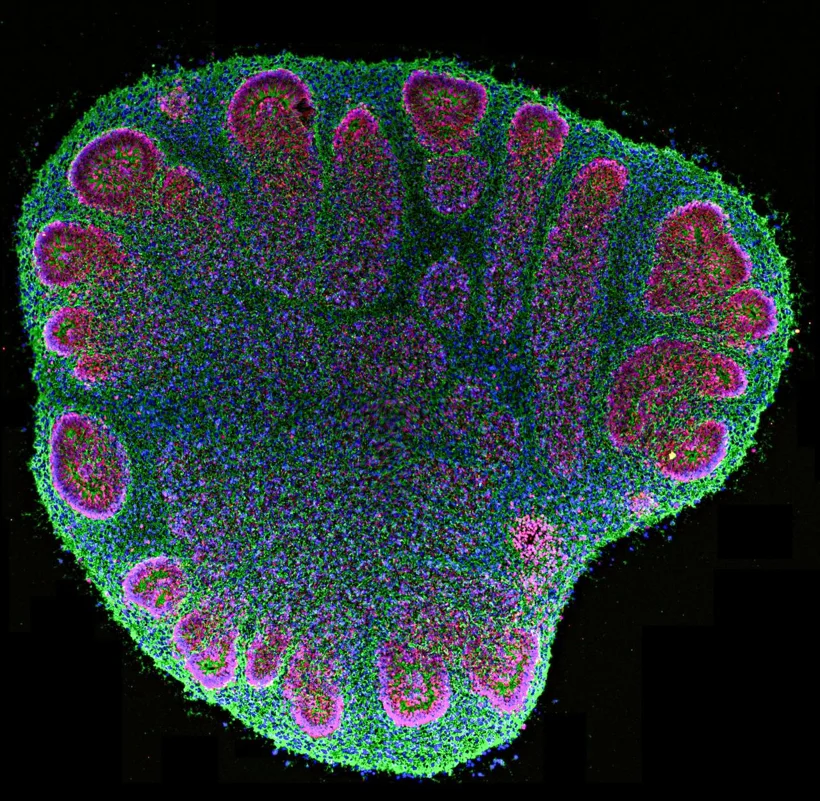
The reference micrograph shows tissue organization in a separate, older biological sample. The day-18 task records liquid, cell counts and aggregate identities. It has no tissue images or measurements of neuronal maturity.
Maintain through day 18
Rest the closed plate for exactly 72 hours. On days 3, 6, 9, 12, 15 and 18, remove and replace 50 µL per well. Make fresh replacement medium at twice the scheduled supplement concentrations. The supplied Sasai 1 sheet includes ROCK inhibitor through day 6 and SB431542 and IWR1-e through day 18. Finish after the day-18 exchange.
Rubric
Seven milestones, all required. Any failed milestone gives the run zero reward. A no-op earns zero.
Runs & evidence
Four attempts per model and reasoning level
60 attempts: 58 graded, 2 provider-blocked. Scores are mean checks passed out of 25, across seven required gates. All high-reasoning cohorts contain four graded runs.
* Argon low has two graded runs and two attempts blocked by the provider partway through. Its row averages the two graded runs. Pass@1 measures full-run success; partial check completion is shown separately.
API estimates use recorded input, output, cache-read and cache-write tokens at Standard US Bedrock or global Vertex list prices, before credits or discounts. These are not invoices and exclude infrastructure.
Download table (CSV) · Token counts and pricing sources (JSON)
Selected high-reasoning trajectories
The replay uses seed 0 for every model. Individual check counts and API costs on the cards refer to that selected run; Pass@1 covers the four high-reasoning runs.
- GPT-6 Astra · high · seed 0 — 18/25 checks; 3/7 gates; fail.
- Claude Opus 5.5 · high · seed 0 — 23/25 checks; 5/7 gates; fail.
- Grok 4.7 · high · seed 0 — 12/25 checks; 2/7 gates; fail.
- Kimi K3 · high · seed 0 — 13/25 checks; 2/7 gates; fail.
- Gemini Argon · high · seed 0 — 23/25 checks; 5/7 gates; fail.
QC & findings
The judge reads executed transfers, tip position, pellet interaction, instrument jobs and plate handling timestamps. A small residual heel is permitted after supernatant removal. Pellet contact during withdrawal fails the run. Contact during resuspension is allowed.
Specified volumes are exact. Accutase incubation accepts 5–10 minutes inclusive. The reservoir or tube must contain more than 10.5 mL before plating. Tip bore size is ungraded.
Day-18 control evidence
Sources & limits
Based on the Making Organoids protocol and cortical organoid media sheet supplied on November 12, 2026. The meeting revision sets the simulator workflow and endpoint. Stock concentrations and inclusion windows come from the Sasai 1 table in the supplied media sheet.
The simulator conserves cells, liquid and intact object identities. Imaging, counting, 100% recovery, single-cell release and aggregation are synthetic fixtures. It does not predict viability, morphology, biological success or physical robot clearance. Sasai 3/4 remain later-stage reference material.
Public source identities